Victor Frankenstein and his creature are two of the most recognizable figures in popular culture, having been a mainstay of literature, film, the stage, comics, TV, and more for 200 years. It all flows back to Mary Shelley’s original 1818 novel, Frankenstein; or, The Modern Prometheus, which not only stands as a milestone in horror, science fiction, and English literature, but has influenced a vast swath of entertainment for two centuries.
The obsessed scientist and his creation have appeared in scores of films and TV shows over the years, but while there have been a number of major, direct adaptations of Shelley’s novel, finding one that is the definitive screen iteration of the book can be a difficult task. The films and TV productions we’ve pinpointed here, while not a complete list, all incorporate elements of the novel to some degree. But many also take extensive liberties as well with Shelley’s narrative and, perhaps most significantly, the nature of Frankenstein’s creation. The Creature in the book, who achieves intelligence, the power of speech, and a decidedly philosophical point of view, is often reduced to a rampaging, wordless brute. As a result, many adaptations make the mistake of turning the Monster into the villain when the real villain of the story is Victor Frankenstein himself.
We’ve ranked the titles below in order from least to most faithful to the text—and found the results somewhat surprising. Quality is a different matter entirely, which is why we’re not ranking these films in terms of how good they are. We’re not going to rehash the plot of Frankenstein here; we’ll assume that if you’re reading this, you’ve read the book or at least seen a couple of the movies.
* Editor’s Note: We are also only including full adaptations of the source material novel (no matter how tenuously adapted). So that disqualifies arguably the most faithful adaptation of both Victor and the Creature onscreen, John Logan’s crossover of 19th century literary characters, Penny Dreadful.
12. Victor Frankenstein (2015)
Directed by Scottish filmmaker Paul McGuigan, Victor Frankenstein is told from the viewpoint of Igor—a peculiar idea since Mary Shelley’s novel contained no such character (the earliest screen incarnation, Fritz, was played by Dwight Frye in the 1931 Frankenstein, while the first such character to bear that name, albeit spelled Ygor, didn’t appear until 1939’s Son of Frankenstein). That alone tells you that this is not an especially faithful adaptation. In fact, it takes all kinds of liberties with the original text. The creature itself, named Prometheus (get it?), doesn’t even arrive until the third act.
Igor is played in this one by Daniel Radcliffe, while James McAvoy essays the title role, and while both actors are wonderfully hammy, the movie itself doesn’t seem to have a coherent vision to it. Interestingly, Charles Dance (Game of Thrones) plays Victor’s father, a role he would portray again a decade later in Guillermo del Toro’s Frankenstein.
11. Frankenstein Unbound (1990)
Based on a 1973 novel by sci-fi legend Brian Aldiss, this film is notable for being the last movie ever directed by Roger Corman, who returned to the director’s chair after a nearly 20-year break. John Hurt stars as a scientist named Buchanan, who creates an energy weapon in the year 2031 that accidentally sends him back to Geneva, Switzerland in 1817 where he encounters Victor Frankenstein (Raul Julia). From there, Buchanan gets involved in the events—more or less—of the original Frankenstein, while also meeting a woman named Mary Shelley (Bridget Fonda) who is observing the story as it unfolds.
Frankenstein Unbound gets even wilder as it goes along since Buchanan, Frankenstein, his Creature, and the reanimated corpse of Victor’s fiancée Elizabeth are flung into the far future by Buchanan’s device. With its meta-aspects and its batshit nutty finale, Frankenstein Unbound deserves points for ambition, even if its disparate parts, like those of the Monnster himself, result in a bizarre patchwork of a story.
10. The Curse of Frankenstein (1957)
Wildly different from the novel, Hammer’s first foray into the Gothic horror for which the company became best known is nonetheless pretty gripping genre entertainment, and Peter Cushing has not only the arrogance and impetuousness of the book’s Victor but an even more enhanced cruelty and amorality. He doesn’t just steal a brain but murders a brilliant professor to boot in order to obtain the squishy gray stuff (too bad it’s damaged in the scuffle). That’s just one way in which the screenplay here veers drastically from Shelley’s text, along with giving the Baron a semi-partner in crime and an affair with his maid.
The Creature, played wonderfully by Christopher Lee, is a true monster, deprived of even the childlike initial innocence of the iconic figure in our next entry. His makeup hews closer to the imagery of the book and gets points for diverging from makeup artist and Boris Karloff’s iconography, but like the latter, Lee’s Creature neither speaks nor develops the thoughts and musings of the book’s creation. Victor even uses him to kill his mistress, a standard which Cushing’s good doctor tried to top in five subsequent sequels.
9. Frankenstein (1931)
As iconic as its imagery is, from the incredible laboratory set to the hunchbacked assistant (Dwight Frye) to “It’s alive!” to, of course, Boris Karloff’s indelible Monster, it’s surprising how loose an adaptation James Whale’s cinematic milestone actually is. Very little of the story from the book, save for the basic premise, survives in this version, which also forces a happy ending on the proceedings even though just 20 minutes earlier, a little girl gets drowned onscreen.
Colin Clive’s Dr. Frankenstein (renamed Henry here allegedly due to anti-German sentiments after World War I in the U.S.) is far too old to be fresh out of medical school, although Clive does capture the arrogance and narcissism of the character in the book. The biggest departure is the creature itself: the philosophical, evolving being of the book is replaced by Karloff’s shambling, mute monstrosity, and any musings about whether he has a soul are simply replaced by the conceit that he’s got the wrong brain in his head. Nevertheless, Karloff wrings real pathos and menace out of his performance, which remains one for the ages.
8. Frankenstein: The True Story (1973)
The irony of this lavish, often thrilling two-part TV movie’s title is that it’s pretty far from being the “true story,” but it’s interesting and absorbing in its own right. Leonard Whiting stars as Victor, paired with the dissolute, misanthropic Dr. Henry Clerval (an excellent David McCallum) as they pursue the latter’s ideas about reanimating dead tissue. The Monster, when it arrives, comes in the form of beautiful Michael Sarrazin, who immediately starts decomposing into a hideous, vengeful golem as Victor cruelly abandons him.
James Mason steals the show as the malevolent, kinky Dr. Polidori, named after one of Mary Shelley’s actual compatriots but here a spin on Dr. Pretorius from The Bride of Frankenstein. Speaking of which, a female creature (named Prima) shows up too, played by a gorgeous, feral Jane Seymour and gorily dispatched (especially for 1973) by Sarrazin when she rejects his advances. Even with Clerval’s brain in his head, the latter only manages to speak a few words, but his sensitive performance, Whiting’s headstrong obsessiveness, and loads of atmosphere capture a worthy amount of Shelley’s essence.
7. Frankenstein (1910)
The very first screen adaptation of Shelley’s novel, produced by Thomas Edison and running a grand total of around 13 minutes, is actually fairly faithful for its first two-thirds or so. Frankenstein (Augustus Phillips) goes away to medical school and becomes fixated on the idea of creating a human being. Much like in the book, he produces his Creature in a cauldron through the use of chemicals and a dash of mysticism, and the subsequent monster (Charles Ogle) was, for many years, perhaps the closest screen version to Shelley’s own description of the creature.
Horrified, Frankenstein abandons the creature and returns home to his father and fiancée, but the creature follows him, not to kill anyone or enact vengeance, but simply to be near his creator. In a weirdly metaphysical climax, the Monster fades into non-existence as the love of Elizabeth and his father prove stronger for Frankenstein. Odd ending aside, Frankenstein remains a landmark for capturing some of the essence of Shelley’s tale and the first one out of the gate.
6. Frankenstein (1992)
All but forgotten since airing in 1992 on TNT, this two-hour TV movie stars a scenery-chewing Patrick Bergin as Victor and Randy Quaid, with some heavy prosthetic makeup slathered on, as the Monster. Directed and written by David Wickes, this is, like several other productions made for TV on this list, surprisingly faithful to the book. It also has lavish production values for a small screen effort, while Quaid makes for a sympathetic creature whose initial innocence believably curdles into rage.
The biggest change here is that the Creature is not a patchwork of dead body parts but a clone of his creator, with the result being that the two share a kind of telepathic link through which they feel each other’s pain. That doesn’t really work, and it undermines the whole “God complex” at the heart of the story. Victor is also shown early on to be experimenting with fusing different animals together like H.G. Wells’ riff on Frankenstein, Dr. Moreau angle that never pays off. There are other changes too. Elizabeth is interested in helping Victor, for example, but overall this retains a lot from the page.
5. Frankenstein (2025)
Surprisingly, Guillermo del Toro’s long-awaited adaptation—and perhaps the magnum opus of his career to date—does not adhere closely to the original text. Victor Frankenstein’s (Oscar Isaac) father, played once again by Charles Dance, is reconceived as a cold, abusive monster while Elizabeth is almost a wholly new character, the fiancée of Frankenstein’s brother William (who plays a much greater role in this) and, as the only character to see the Creature (Jacob Elordi) for what he is: the film’s conscience.
While many of the themes of del Toro’s previous work are taken from Frankenstein—the creature as misunderstood outcast, for example—he also plays up the father-son dynamic much more forcefully, paralleling Victor’s relationship with his dad to that of Victor and the Creature he creates. Elordi provides perhaps a definitive performance both physically and intellectually, while adding an emotional aspect that makes the film the most poignant version of the story ever presented.
4. Mary Shelley’s Frankenstein (1994)
Kenneth Branagh’s film, with a screenplay by Frank Darabont (who later disowned the finished product), is faithful to the text in the strictest sense. Almost everything you see on the screen is taken from the book, with the exception of the “Bride of Frankenstein” segment in which Helena Bonham Carter’s Elizabeth is reanimated into a self-loathing Creature after her brutal demise. But the film makes several big mistakes along the way: the direction is, in a word, awful, with the camera never pausing for a moment and the movie rushing headlong through every scene like it’s late for a hot date. But the movie also repositions Frankenstein (played by Branagh) as almost an action hero and his experiments well-intentioned, as opposed to the result of arrogance and hubris.
The final blow is the miscasting of Robert De Niro as the Creature. His performance and approach are spot-on—this is, if you were reading it on the page, a terrific rendition of Shelley’s thoughtful yet deeply wounded creation. But De Niro cannot shake his screen persona as a downtown New York tough guy, for better or worse. Again, this is a largely faithful adaptation, as long as you don’t watch the actual movie.
3. Terror of Frankenstein (1977)
Also known as Victor Frankenstein (that’s the onscreen title on the print we saw), this obscure 1977 Swedish-Irish production was directed by a Swede named Calvin Floyd and is notable for the title role being played by Leon Vitali, a British actor who was perhaps best known for working as personal assistant to Stanley Kubrick on his last three films, and later overseeing the restoration of Kubrick’s films after the latter’s death.
Vitali plays Frankenstein as a brooding man-child with not a lot of range, but the right level of arrogant superiority, while Swedish actor Per Oscarsson makes for an interesting, physically imposing, and thoughtful monster—even if his makeup could be a little more horrific. The film is clearly low-budget and rather drably shot, but very faithful to much of the novel (it’s the first screen version to include the framing device of the ship trapped in ice up at the Arctic). At 92 minutes in length, it doesn’t give the story a lot of room to breathe, making it feel faithful and truncated at the same time, but it may be the most naturalistic version of the tale put on the screen to date.
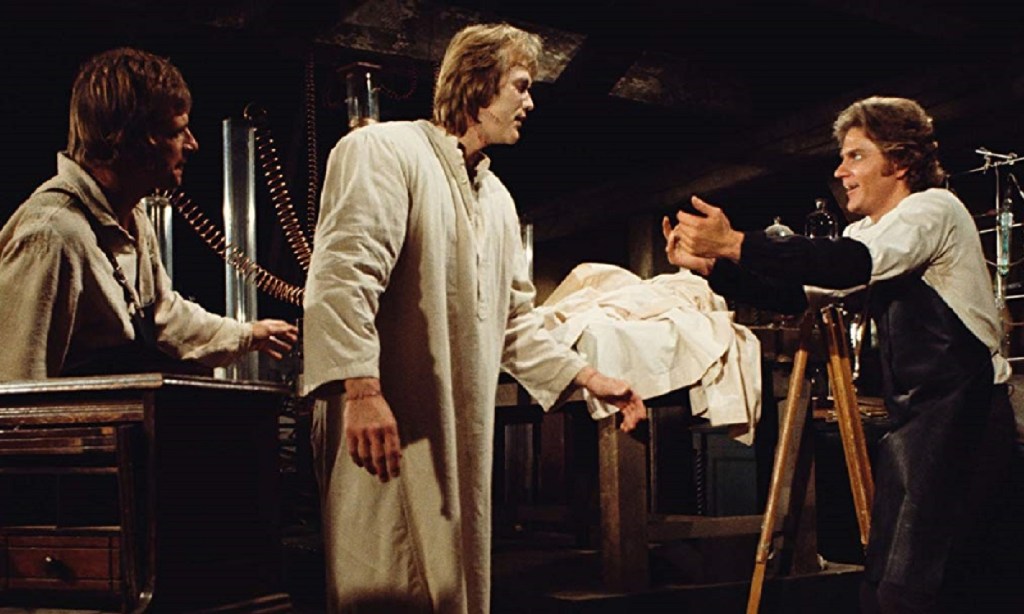
2. Dan Curtis’ Frankenstein (1973)
It was almost inevitable that Dark Shadows creator and TV horror auteur Dan Curtis, who also gave us gems like The Night Stalker and Trilogy of Terror, would try his hand at Shelley’s classic. Curtis produced and co-wrote this one, while leaving the direction to Glenn Jordan. The resulting two-part movie (which runs at three hours combined, and that’s without commercials!) stars Robert Foxworth (Damien: Omen II) as Victor Frankenstein and Swedish actor Bo Svenson (Walking Tall: Final Chapter) as the Creature.
Foxworth seems a little too American as Victor, but otherwise this is a credible and faithful take on the novel—in fact, the most faithful produced up to that point in time, and the first to feature a Creature that actually speaks in intelligent, articulate fashion. It also features a version of Elizabeth (Susan Strasberg) with much more agency and independence. On the downside, Svenson’s Creature is not that horrific-looking and a rather decent fellow, the ending is moved from the Arctic and altered, while the film as a whole suffers from stiff TV movie direction and a clearly low budget. Yet it must be recognized as the first true attempt to film the book as written.
1. Frankenstein (2004)
Who could imagine that arguably the most faithful version of Frankenstein would be a Hallmark Channel TV movie? Shown in two parts in October 2004, this relatively sumptuous adaptation is directed by Kevin Connor, who helmed such ‘70s drive-in fare like From Beyond the Grave and The Land That Time Forgot. While the film has its dull stretches and shaky performances (William Hurt’s German accent as Victor’s mentor is unfortunate), it does not play as Hallmark fodder and features just about every incident from the text, including the murders of Victor’s younger brother, his friend Henry Clerval (a young Dan Stevens), and his betrothed Elizabeth (Nicole Lewis), as well as the Creature (Luke Goss) learning of English by observing a family. It even includes the prologue and epilogue set in the Arctic.
Victor’s (Alec Newman) initial hubris and descent into self-recrimination is captured well here, and the creature is presented in a sympathetic light too (again, strangely, the makeup could be a tad more horrific). Connor and writer Mark Kruger wisely approach the story as a tragedy, although we daresay the horror quotient could be turned up a notch or two more. It may not be the best version, but it probably takes the crown for most literal adaptation of the book to the screen.
Guillermo del Toro’s Frankenstein is streaming now.
The post Frankenstein Movies Ranked in Order of Faithfulness to the Mary Shelley Book appeared first on Den of Geek.




0 Commentaires